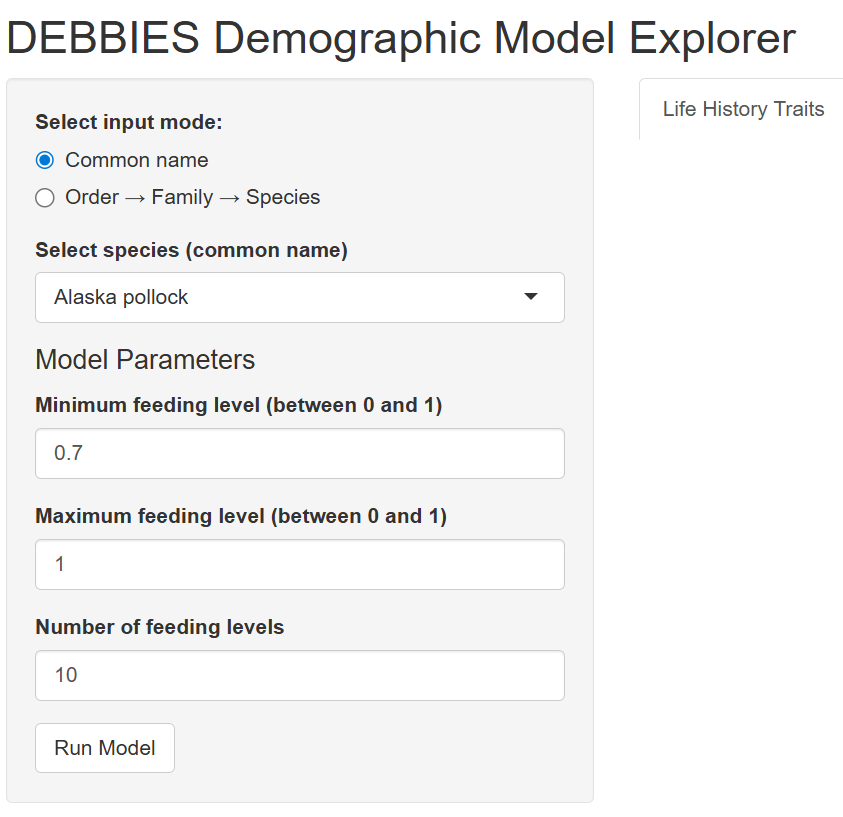
The DEBBIES Demographic Model Explorer (found here: DEBBIES Shiny App) is an interactive tool designed to investigate how biological traits influence population dynamics across ectothermic species. Built on dynamic energy budget theory and demographic modelling, the app allows users to select a species and simulate its life history traits under varying feeding conditions. Whether you’re a biologist exploring trait sensitivity or simply curious about species ecology, DEBBIES offers a powerful way to visualise and compare demographic responses in a user-friendly format.
The interactive app lets you select a coldblooded species (Figure 1) from the drop down menu in one of two ways: by a species’ common name or by selecting Order, then Family then the Latin species name.
Please credit your use of this App by citing the original paper:
Smallegange, I.M., Lucas, S. 2024. DEBBIES Dataset to study Life Histories across Ectotherms. Scientific Data 11, 153. doi:10.1038/s41597-024-02986-x.
Using dynamic energy budget integral projection models (DEB-IPMs: see YouTube video below), the Shiny App computes:
- Generation time (number of days required for the individuals of a population to be fully replaced by new ones)
- Age at sexual maturity (number of days that it takes an average individual in the population to become reproductive)
- Progressive and retrogressive growth (probability of growing to a larger, respectively, smaller length)
- Mean sexual reproduction or recruitment success (mean per-capita number of recruits across the length domain)
- Degree of iteroparity (variation in age at reproduction)
- Net reproductive rate (mean number of recruits produced during the mean life expectancy of an individual in the population)
- Mature life expectancy (number of days from the mean age at maturity until the mean life expectancy of an individual in the population.)
- Population growth rate (the multiplicative factor that describes how a population’s size changes in discrete time steps; if it equals 1, there is no change in population size)
- Demographic resilience (the speed at which a population returns to its stable structure after a disturbance)
How to use the DEBBIES Interactive App:
- Select your species of interest.
- Set the feeding level range (between 0 and 1, representing ‘stomach fullness’) and number of steps (controls how many scenarios the model calculates). I recommend anything above a feeding level of 0.7.
- Click Run Model to generate outputs:
- A figure with panels showing the calculated life history traits across feeding levels.
- A figure showing which parameter has the most influence on population growth rate (indices correspond to: 1 = length at birth, 2 = length at puberty, 3 = maximum length, 4 = maximum reproduction rate, 5 = von Bertalanffy growth rate, 6 = adult mortality rate, 7 = juvenile mortality rate).
- The list of species specific parameter values that are used to calculate the outputs in the above figures.
- A table tab for numerical outputs of all calculated traits.
For more details on DEBBIES and its applications, see the 2024 paper in Scientific Data.
The original dataset can be downloaded here.
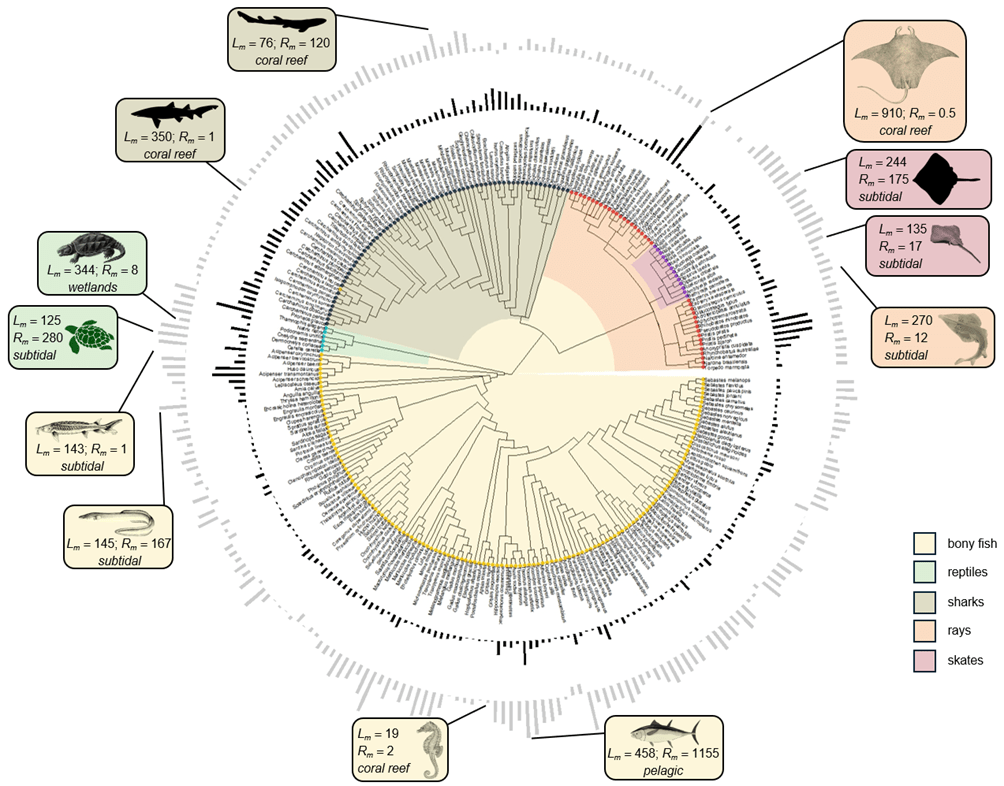
Figure 1. A phylogeny of species that can be analysed using the interactive DEBBIES Shiny App, coloured by clade, is shown with bar plots representing maximum length (cm) (black bars) and log-transformed, maximum reproduction rate (# year-1) (grey bars). A range of life histories with contrasting maximum length and reproduction rate values across clades are highlighted, clockwise from the top right: Mobula birostris (giant manta ray), Scyliorhinus canicula (small spotted catshark), Bathyraja parmifera (Alaska skate), Glaucostegus typus (giant guitarfish), Thunnus thynnus (Atlantic bluefin tuna), Hippocampus erectus (lined seahorse), Anguilla anguilla (European eel), Acipenser brevirostrum (shortnose sturgeon), Carreta carreta (loggerhead sea turtle), Chelydra serpentina (snapping turtle), Carcharias taurus (sand tiger shark) and Scyliorhinus canicular (small spotted catshark).
 isabelsmallegange.com
2 Comments Add yours